
Mastering Model Context Protocol (MCP): The Vital Link Between AI and Your Systems
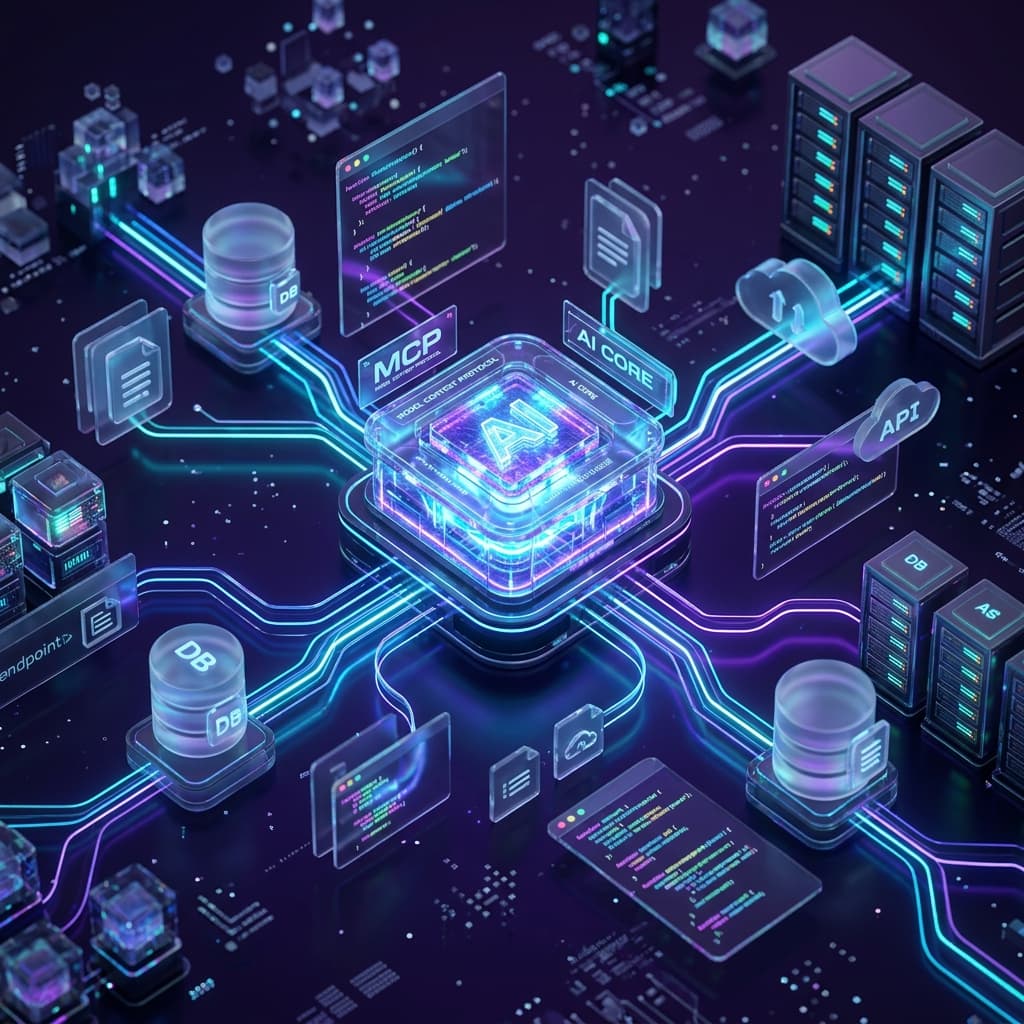
🚀 The Context Gap: The Isolation of LLM Brains
Whether you are collaborating with Claude, GPT-4, or any advanced autonomous AI agent, they all share a fundamental bottleneck: complete isolation from real-time context. An AI model can write elegant, syntactically correct code, but it cannot natively locate your .env configuration file, check if your newly configured domain is throwing a 404 error, or read your local CHANGELOG.md to grasp project velocity.
This is precisely why the Model Context Protocol (MCP) was introduced. MCP is an open-standard protocol designed to establish a secure, uniform, and two-way bridge, allowing LLMs to programmatically and safely "touch" your local data, filesystems, and development tools.
💡 Understanding MCP (From an Architect's Perspective)
Think of the LLM as an exceptionally talented, world-class chef locked inside a windowless room with no ingredients. MCP acts as a high-speed conveyor belt system connecting this room to both your pantry (your databases, files, and code repositories) and the kitchen tools (your CLI utilities and runtime environments).
Instead of relying on tedious manual copy-pasting, MCP enables the AI to programmatically query your workstation:
- "Fetch the list of published posts from Hashnode."
- "Verify if the domain nhantruong.dev is resolving and redirecting correctly."
- "Read the environment variables file to safely extract API configuration details."
🛠️ Case Study: Architecting mcp-blog-manager
In our recent production system upgrade, I built a dedicated MCP Server named mcp-blog-manager. This tool acts as the exclusive command interface allowing our AI assistant (Antigravity) to orchestrate and maintain the entire nhantruong.dev blog ecosystem.
1. Anatomy of a Standard MCP Server
The server's design relies on three technical pillars:
- Tool Definition: Explicit JSON schemas declaring the exact capabilities exposed to the LLM (e.g.,
inspect_blog_domains,count_hashnode_posts). - Stdio Transport: An ultra-fast, local-only communications channel running over standard input and standard output, guaranteeing system secrets never touch the public internet.
- Integration-First TDD: Leveraging real agent simulation scripts to test raw JSON-RPC transport payloads rather than relying solely on isolated unit tests.
2. Local vs. Remote MCP: A Strategic Trade-off
Choosing the correct transport layer is essential for system security and network architecture:
- Local MCP (Stdio-based): Runs directly on your workstation. The AI gains rich, low-latency access to the workspace without exposing anything to external ports. Excellent for solo developers and highly sensitive codebases.
- Remote MCP (SSE-based): Uses Server-Sent Events (SSE) over HTTP. Perfect for engineering teams connecting shared AI agents to corporate microservices and shared cloud environments.
💡 Key Takeaways & Architectural Insights
Engineering custom MCP Servers is about far more than just adding API endpoints; it is about scaling your own technical bandwidth. When an AI can access live, secure system context, it transforms from a passive chat utility into an active, high-leverage technical partner—reclaiming up to 80% of routine management overhead.
In this AI-driven era, moving to an elite engineering level is no longer just about writing code faster; it is about designing these robust semantic bridges.
🏁 Conclusion
MCP is not merely a technical protocol; it represents the new standard of human-AI collaborative software engineering. Do not settle for simple chatbots. Build your own semantic pipelines so that your AI models can truly understand, traverse, and support your systems.
This article is part of the Blog Content series at nhantruong.dev
Tech Newsletter
Get automated notifications and the latest tech insights delivered directly to your inbox.